|
Hunger hormone makes food look good: Study
THE CANADIAN PRESS
Helen Branswell
May 06, 2008
A hormone produced in the gut spurs people to eat more by making food seem
more appealing, new research reveals, proving the wisdom behind the
oft-repeated advice that people should never go food shopping when they are
hungry.
"It's something that people knew but this explains it," senior author Dr.
Alain Dagher from Montreal, where he is a neurologist with McGill
University's Montreal Neurological Institute.
Dagher and his co-authors showed that the hormone, ghrelin, activates parts
of the brain involved in sensations of pleasure or reward – the same parts
of the brain affected when addicts indulge in their drug of choice.
Ghrelin, which the gut generates to tell us we are hungry is also produced
when we are under stress, Dagher said, underscoring the aptness of the
phrase "comfort food." Eating drives down levels of ghrelin.
"Ghrelin is a gut signal – it's the way the gut communicates with the brain
to make you hungry," explained Dagher, who specializes in the workings of
the brain in drug addiction.
"And how it does that is by increasing the rewarding nature of food cues, by
making food pictures or food thoughts or food objects more attractive to
you. And therefore increasing the probability that you will eat."
The work, which was funded by a grant from food and household cleaning
products giant Unilever PLC, was published Tuesday in the journal Cell
Metabolism.
The study was hailed as important by experts who had no involvement in the
work, including a University of Miami researcher who has done a similar
study looking at the activity stimulated in the brain by the hormone leptin,
which tells our brains when we've had enough to eat.
"I think that's exactly the direction that research in this field needs to
go, to show how these food related signals are impacting on brain function,"
said Dr. Julio Licinio, chair of the university's department of psychiatry.
Dagher said ghrelin's ability to trip the reward circuitry of the brain is
probably an evolutionary holdover from the time when food was scarce and
getting it came at a physical cost. In order for the human species survive,
our ancestors had to view expending the energy to secure food as more
compelling than the impulse to conserve energy.
"So our brain evolved to make us have this extremely powerful drive to eat.
And ghrelin is one of the signals – it may be one of the most potent signals
– in that drive to eat," he explained.
The study involved giving injections of ghrelin or a placebo to volunteers
three hours after they'd eaten a standardized meal. The trial subjects were
then shown pictures – some of different foods, some of scenery – while their
brains were being scanned using magnetic resonance imaging.
When those who had received the ghrelin were looking at the food pictures,
the MRIs showed the portions of their brains known to be involved in
pleasure – the network of so-called reward centres – lit up, signalling they
were activated.
That pattern of brain activation was not seen when they were looking at the
pictures of scenery or when the people who received the placebo injection –
saline solution – viewed the food pictures.
In addition, parts of the brain involved in vision were more active when the
volunteers who got the ghrelin injection looked at the pictures of food,
suggesting they were actually processing the visual information better. They
later remembered the food pictures better as well.
The fact that the same reward circuits are activated in drug addiction
suggests it's reasonable to believe that high-calorie food might have
greater appeal – and greater addictive potential – than lower-calorie
alternatives, Dagher said, though he hastened to say this study doesn't
prove that.
In fact, the researchers did not try to measure in this study whether
burgers and pizza – a couple of their pictured foods – triggered greater
brain activity than did lower calorie foods such as salads, which were also
shown.
They did find, though, that while all those who got the ghrelin injection
responded, the level of response differed among the individuals.
That underscores the complexity of the system – and the challenge of trying
to use the information to find ways to modify eating impulses, said Dr.
Diane Finegood, scientific director of the Canadian Institutes of Health
Research's Institute of Nutrition, Metabolism and Diabetes.
"That illustrates that we're not all created equal. And that for some
individuals, the challenge of counteracting what may be a biological
phenomenon can be greater," said Finegood, an obesity researcher at Simon
Fraser University in Burnaby, B.C.
While the degree of the drive may differ from person to person, Dagher said
it is nonetheless extremely difficult for people to ignore the signals
ghrelin sends.
"Ultimately these signals are basically very powerful," he said. "Because
they exist so that we don't die out as a species."
And while altering levels of the hormone may offer opportunities to modify
the desire to eat, tinkering with hormones that fuel the brain's reward
centres might have undesirable consequences, such as depression, Dagher
admitted. "There is a risk to inhibiting this brain system."
Licinio agreed but said development of ghrelin blockers should be pursued.
"I think that the challenge is that because these drugs have to act at the
level of the brain and impact on behaviour, when you mess with brain and
behaviour you can push people towards depression, psychosis or other things
that you don't want to go there," he said.
"So it makes it a little tricky. But I mean it's a matter of trial and error
until you find the right drug that doesn't have those side effects that you
don't want."
###
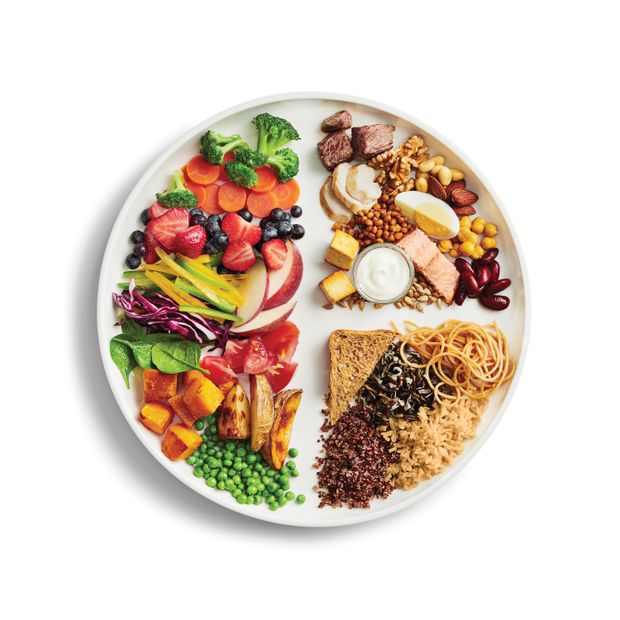
Canada's Food Guide to Healthy Eating
For most people of Asian culture and some
in Western Culture ....
Food is a medicine for their bodies.

Click on Me to go to the
FarmGate Bookstore
|